
Chapter III
GROUCHO IN SPIRIT

I
"Are you Groucho Marx?"
"That's right, sir."
"But what are you saying, man? You died many years ago!"
"Well, you know what I say to that, my friend? Don't trust appearances, and don't pay much mind to what people tell you. People lie a lot. I'm just warning you. You're free to believe whatever you please."
"No, I believe you—in fact, I'm almost convinced you are Groucho Marx! The face, of course, is the same, and you seem to express yourself just like him. So I have no reason to doubt. You are undoubtedly Groucho."
"I'm glad you trust me, my friend! You'll see, throughout our conversation—which I hope will be long and fruitful, especially for you, as you are much younger than I and therefore have more to learn—that you will keep finding proof that I am who I say I am."
"That sounds perfect to me. Placed to meet you in person, Mr. Marx. I must tell you, taking advantage of this unexpected moment, that I have always been a great admirer of yours and your brothers. I've seen all your films, and as far as you're concerned, I've also read almost all your books."
"Terrific, a fan! It makes coming back for a stroll on Earth a real pleasure. It's always very nice to be well-received after being absent for so long!"
"Forgive my boldness, Mr. Marx! But, are you alive, dead, a ghost, or have you been reincarnated as yourself?"
"Well, well, my dear friend, I see you are a very curious person! But hey, let's give it time. Though perhaps what I am matters less than the conversation we can have and the conclusions we draw. And forgive me for repeating myself, but you will undoubtedly benefit more than I, though I don't doubt I might gain something from what you have to say to me. Do I make myself clear, young man?"
"Yes, Mr. Marx, perfectly clear! And by the way, I'd prefer you to address me informally, I feel more comfortable that way. I, of course, respect you very much, so I'll continue to address you formally. Forgive the redundancy."
"Don't worry, friend! Despite my age, I feel young. In fact, I think this provisional return trip to Earth has taken a few years off me, so you can call me 'tu', just as I am doing with you. You can call me Julius."
"Then you—pardon me, I meant you!—can call me Paquito. That's how my family and friends know me."
"Well, pleased to meet you, Paquito!"
"Pleased to meet you, Julius!"
"If this were a scene from one of the movies I made with my brothers, Harpo would greet you by honking his horn.
Honk, Honk, Honk…!
II
"If you don't mind, Julius, although we have a lot to talk about, I'd like to know quite a few things about you—nothing personal, of course, those belong to the intimacy of your private life."
"Don't worry, kid, fire away! I have nothing to hide, but I'll only answer what I feel like answering."
"Of course, Julius, naturally!"
"I must also tell you that not everything told about me is true, even regarding quotes people say I uttered when I didn't, but well, that matters little now. What counts is the present. The here and now. Don't you think?"
"Yes, I agree with you!"
"Great, then! So, it's up to you. Though I must warn you, sometimes my imagination runs away with me and I start performing, remembering my acting days, and I might just invent a few little lies because I find it fun. Since I hasn't practiced creativity in a while, it might do me good to develop some fiction, as if I were writing a movie script, or a scene for a stage comedy, or even a book—I don't know, I'll improvise as I go."
"Perfect, Julius, whatever you decide works for me. For me, it's already a tremendous honor to be here right now and to be able to talk to you man to man!"
"Paquito, don't be modest, kid! I'm a human being like any other—not flesh and blood as I once was, but well, in spirit I'm the same as ever. A man, perhaps a bit peculiar, but a man after all."
"All right, Julius. I'd like to start by asking if it's true that once when you traveled to Germany, you visited Hitler's bunker and danced in it?"
"Ha, ha, ha…! I wasn't expecting 그 question, Paquito. Well, yes, I did a sort of Charleston, but it seems the people accompanying me didn't find it very funny. I never quite knew why. I don't know if it's because I danced poorly, or because those accompanying me were Nazis who admired Hitler and were offended that I mocked the Führer in what had been his final home, or perhaps it was just because Germans are too serious to appreciate my sense of humor. But that's what happened, Paquito."
"But how did you come up with the dance?"
"Well, it's very simple. The area where Hitler's bunker had been was surrounded by rubble. I climbed up as best I could, about five meters or so, and once I was at the very top, I gave them the Charleston. It was improvised, and I admit it was irreverent, but that's just me."
"I believe you liked playing the guitar very much. Is that true?"
"Yes, I loved it. In fact, I became friends with a great master of the classical guitar, a countryman of yours named Andrés Segovia, who even gave me a few short lessons that helped me a lot."
"Is it true that Federico Fellini offered you a role in one of his films?"
"Yes, but the truth is I didn't much feel like it at the time. I recognize that back then, he was considered one of the best directors in the world—and in fact, experts still value him as such—but to truly enjoy things, you have to do them when you really want to, and at that moment, working with friend Federico wasn't among my priorities. Don't you think I'm right?"
"I totally agree with you, Julius."
"Hey, Paquito! How about we take a little break? I feel like relaxing for a bit and having a coffee."
"No problem at all, we do whatever you prefer!"
"With friends like you, it's a pleasure, kid!"
"I'll have a little coffee too, Julius!"
"Then let's get to it, my boy!"
After a half-hour break and a couple of coffees each, the two conversationalists continued talking about things both human and divine—though in this case, it might be more accurate to say chimerical, or even hallucinatory. But well, the label matters little, so let us focus instead on the narrative.
In the end, all that talking can be exhausting—that's what happens when you wag your tongue nonstop. Groucho was a true specialist in that, and Paquito, as a good student, was no slouch either. So there came a point where the dialectical exhaustion demanded a pause, and both decided to postpone their interesting chat until the next day. There would be enough time then to continue the conversation, and for Julius (Groucho), with his unleashed verbosity, to continue telling an astonished yet enthusiastic Paquito all kinds of anecdotes from his exciting life—a life that possessed all the necessary ingredients to be anything but boring.
III
And as was to be expected, the conversation (impossible, imaginary, or real—one never knows, nor will we ever be able to find out) between Julius and Paquito continued. But this time it was the former who, without the latter asking a thing, began to talk nonstop, while the young man remained motionless, mouth shut, completely attentive to what his admired Groucho was telling him.
"My dear Paquito! Listen carefully, because I am going to tell you some things about my life that you might not know, or that you might have heard someone tell and they are lies, or you might have read things about me that aren't true. But that matters little; what counts is what I'm going to tell you now. Call them anecdotes, if you like, or whatever you please. They are just loose little stories of things I lived through. For example, did you know that my brothers and I were on the verge of filming a movie with the great Billy Wilder? (A true phenomenon as a director, who filmed mythic and extraordinary movies like Sunset Boulevard, Some Like It Hot, Witness for the Prosecution, The Apartment, The Seven Year Itch, and so many others). I think it was in 1960. We were all in agreement, and it was going to be the return of the Marx Brothers to the world of cinema, and through the front door, but in the end, it wasn't to be. Besides, the following year, unfortunately, Chico died (though in our particular universe, we'd better say he moved to another dimension), so the project went down the drain."
"I'd also like to tell you the story of my mustache, which became almost as famous as I did. At first, people thought the mustache was real, although the truth was it was a fake. But one day, I was running late for a performance at the theater and didn't have much time before going on stage. The spirit gum for the mustache was nowhere to be found, and I had no choice but to paint it on with greasepaint, and that's how it stayed for a long time—until I decided to grow a real one for good, that is, from my own hair. It was much more comfortable, and from then on, I saved quite a bit of money on greasepaint, just as I had previously saved on glue. Call me stingy if you want, but one must avoid wasting money whenever possible!"
"Another anecdote I'd like to tell you is that in the year… well, I don't remember right now, but it doesn't matter. The point is that we filmed a silent movie, the only one we ever made, titled Humorisk. Well, the curious thing about it is that the movie was never released because it disappeared. No one knows how, but we never heard anything more about it. It's like one morning your wife argues with you, leaves the house, and doesn't come back for lunch or dinner (which isn't so bad if you're already tired of her). Gone forever. Well, the same with the movie. Although rumors accused me of having made it disappear—or rather, of having burned the negative because I didn't like how the final cut turned out. Well, none of that, it's not true. They accused me of being a common arsonist, a sort of cinematic Nero. Good heavens, the things people are capable of inventing just to have something to talk about!"
"Well, Paquito, I see you're very quiet—that means you find everything I'm telling you interesting. You might be a bit surprised that all my stories jump back and forth in time, that is, they don't follow a chronological order, but you have to keep in mind that at my age, memory fails me sometimes. Nevertheless, I remember almost everything that happened in my life (occasionally, I have certain lapses), except for the bad things, since I always try to forget those. Though it's inevitable that the usual killjoy appears to poke his nose in, reminding me of things I never want to hear about again."
"What I'm telling you is what comes out of the archive I have in my brain, but the folders are a bit disordered, which is why there can be a huge gap in years between one story or anecdote I mention and the next."
"Don't worry, Julius, you know that's not a problem for me. I'm delighted to be here listening to everything you tell me with full attention!"
"That's the spirit, kid! The best thing that can happen to an artist is to get the audience completely committed to the cause—that way, success is guaranteed. Therefore, I'll continue, though you'll have to excuse me first, Paquito, I need to go to the bathroom. You know that at my age the prostate is a real bastard and frequently a total pain in the neck. I'm sorry to be so blunt, but it's the honest reality. Getting old is what it is."
"Of course, Julius, by all means! I think I need to pee too, so I'll join you…"
Glug, glug, glug…! Splosh, splosh, splosh…! Shhh, shhh, shhh…! Plink, plonk, plonk…! (The variations in noise occur depending on the intensity of each one's urination).
And then: Swish, swish, swish…! That is, the liquid goes down the pipe. Reproducing the sound of a flushing toilet is even more complicated, so we leave it to the reader's free imagination. In any case, we invite anyone interested in discovering sounds identical or similar to the mentioned case to use the information available in various frequently used onomatopoeic dictionaries.
IV
"How good one feels after a good piss! Though after a certain age, it's better to just leave it at a 'simple piss,' and be thankful for it! The days of the powerful stream are far behind us!"
"Ha, ha, ha… I'm sure they are, Julius!"
"Well, Paquito, let's keep chatting. But hey, you ask me something, because I think without realizing it, I'm monopolizing the whole conversation, and I don't want to be selfish, so tell me what you want to know, or what you feel like talking about."
"Julius, I thought that if you don't mind, I'd like to ask you things about specific topics to get your opinion."
"Well, fire away then, kid, I'm listening!"
"Ok. I'll give you a topic and you respond.
To start, I'd like you to talk to me about love, and the conclusions you've drawn throughout your life, the fruit of your experiences with women."
"Undoubtedly an interesting topic, kid, I like it, so let's get to it! Love, Paquito—many confuse it with a stomach ache, or even worse, with diarrhea. And when that discomfort passes, they think they're cured… but then they get married, and then there's no remedy unless they resort to divorce, which is the only possible method to fix the mess. Hence, it isn't hard to deduce that the primary cause of divorce is, precisely, marriage. Well, I think you understand what I'm saying, right, Paquito? I get a bit tangled up sometimes."
"No problem, Julius, it's clear as day! But go on, tell me a bit more on the subject."
"Well, here I go. I'll continue with marriage, which is undoubtedly a great institution, but it's only for those who want to live in a great institution. At first, some think that's where they want to be, but with time they realize that, although they like the institution, they need to visit other institutions and not stay always in the same one—in fact, that happened to me many times. I'll also tell you, and many think like me, that marriage kills love in the long run. Especially that early romance, when everything is rose-colored."
"To look no further, I've had many romances. And marriage always ended them. Not so much because of the institution, but because of the woman I was married to at the time. And the thing is, if you don't have the romance with your lady, it's difficult to make it compatible with another woman and your own wife, which would be ideal. As for love, I can only tell you that true, authentic love is very hard to find, as it only appears once in a lifetime—of course, after that, there’s no way to get rid of it! I don't know if you quite understand everything I'm telling you, but well, you know me. My thing is to focus on the absurdity of things—that's how I lean, and it's been that way all my life. Now, at my age, it's too late to change."
"Your way, friend! Everything you tell me is very interesting and not at all absurd, at least for me—if others think otherwise, that's their problem! And now, for a change of subject, I'd like us to talk about money, does that work for you?"
"Very well, I like money! You know I've always had a reputation for being cheap, and it's true, I won't deny it, but well, I just don't like to squander. Earning money takes a lot of work—it certainly cost me a great effort—but I don't think I'm selfish either. I'm satisfied with having the essentials for a good life: little things to make me enjoy a well-deserved well-being, a small yacht to go out fishing, a small three-story mansion with a garden and pool, a small fortune with several hundred thousand dollars in the checking account. In short, kid, small worldly pleasures to enjoy life, which is short and you have to make the most of the time—you know what I mean!"
"Clear as day! How about you tell me now about the human being?"
"Complicated matter, certainly! As you can imagine, especially because of my age, I've been able to meet, over so many years, an enormous number of people of all kinds: black and white, rich and poor, smart and dumb, lowlifes and lovely people. The conclusions I've been able to draw, generally speaking—since it would take too long to delve into the specific personalities of one or another—are as follows. One of the most decisive aspects I observed in many individuals I've met is that when someone looks like an idiot, they generally are an idiot, and this can be confirmed the moment they sooner or later act like a total idiot. I've also been able to distinguish very well those who are fools, who are those types who never laugh at anything, even if you tell them something tremendously funny; and likewise, on the opposite side, I can spot the morons, who are those who laugh at everything, even if you tell them things that aren't the least bit funny. There is also another class of individual, which we could define as ignorant, who is usually very dangerous when you have them close by, especially when they exercise their ignorance—that one who, instead of remaining silent despite seeming like a moron, prefers to open his mouth and say something stupid, to prove that he is indeed a complete fool. I've known many, but the list is so long it would be endless, and we'd need several days to complete it."
"Ha, ha, ha, I'm sure! I could also add more names to make the list even longer! Well, Julius, let's move on to another topic. What can you tell me about old age?"
"First off, it's a bitch, and since I'm already in it, I know very well what I'm talking about. But well, it's the law of life and there's no choice but to accept it. And as for my experiences as a permanent member of the senior citizens, what I can tell you is that being old means having more and more experience and less and less hair. Having more heart attacks than erections, and also that the dirtiest thing you can do with your wife is have her give you a manicure, or you give her one. How about we take a break and continue talking tomorrow? I think I'm a bit sleepy…"
Paquito, returning to reality, recovers his true name: Don Francisco. He too belongs to that old age Julius speaks of, though he doesn't know it, or doesn't want to accept it. He is happy living in that past which for him is real, though it fell behind years ago, like a dream from which he doesn't want to wake.
V
"Paquito, would you like to be an actor?"
"I'd love to, Julius, but I've never acted in my life!"
"Don't worry, man, it's not very complicated!"
"I think I'm a bit clumsy for acting!"
"Nonsense, Paquito, you just have to set your mind to it. At first I hadn't the foggiest idea how to talk or move, I felt ridiculous, but I learned in no time!"
"If you say so, Julius, I believe you—you're the master!" "That's the spirit, kid, who's afraid?"
"And what do I have to do?"
"Well, it's very easy! We're going to rehearse a scene from the movie Duck Soup, and you'll play Chico's part to give me the responses in the dialogue. Here you have the sheet with the written text—just read along. I don't need it; I have an excellent memory for dialogue, and I remember it perfectly from the day we filmed the scene. You'll know it by heart too once you've repeated it at least a hundred times, ha, ha, ha, only joking, man…! Are you ready, Paquito?
"Yes, Julius, whenever you like!"
(*)
Groucho: Well, and how many men do you have in your army?
Paquito (substituting for Chico): Well, we have over a hundred thousand men.
Groucho: That's not fair, we're outnumbered—since we only have fifty thousand, more or less.
Paquito: All right. To be fair, we'll give you twenty-five thousand and that way we'll be even.
Groucho: That's it, fifty-fifty, to balance the matter. And can you tell me, how many battalions do you have?
Paquito: Well, I'll tell you we have two battalions and a guy who looks Chinese who goes his own way.
Groucho: I'd like you to keep working for me. That way, I could ask you to resign or even fire you whenever I felt like it. And how are you fixed for cavalry?
Paquito: We have over five thousand men, but horses—what you'd call horses—we haven't got any.
Groucho: Well, isn't that something! I have just the opposite—that is, five thousand horses, but no men.
Paquito: Well, I have an idea! Your men can ride our horses, and that'll solve the problem. I think that would be a good solution.
Groucho: The truth is, it's not a bad idea. And if your horses get tired, we can do it the other way around, and have the horses ride our men for a change (Paquito nods, staring fixedly at Groucho, following the instructions on the paper, but he puts so much emphasis into his facial expression to convey the 'yes' that he's left with the face of a complete simpleton, very similar to the ones Harpo used to make in some scenes; thus, without meaning to, he has produced a perfect imitation of the 'mime' Marx brother). I don't mind lending you our horses, but you have to promise me you'll carry out your corresponding maneuvers; otherwise, no deal.
Paquito: Oh, sure, of course! We perform maneuvers with the horses every morning, except when it rains, because we don't have enough umbrellas to cover all the animals.
The scene ends and Paquito looks seriously at Groucho, anxiously awaiting the master's opinion.
"Bravo, kid, you didn't miss a single line! I think you could have been a wonderful actor. You inhabit the character. And now that Chico can't hear me, I think you've done even better than he did."
Paquito smiles and his face expresses a state of total satisfaction, or happiness—even a mixture of both. In doing so, once again, without any effort or explicit search for it, he is left with that same consummate fool's face, in another successful imitation of Harpo.
"Oh, thank you, Julius, coming from you that's quite a compliment!"
"Don't mention it, man, don't be modest! You stepped into the role like a true acting professional. My brother Chico was quite informal, so sometimes he didn't take his work too seriously and scenes had to be repeated several times because he frequently messed up. Harpo, however, was more professional; he behaved as you have—with seriousness and very responsible toward his work. You remind me of him in that respect."
"Thank you, Julius, that's a great compliment on your part!"
"Stop thanking me already, Paquito, you sound like a broken record, man!"
And that was how Paquito realized one of his most desired dreams. It was a wonderful night in which the Fairy Godmother of Fantasy, at other times so elusive—especially for those with imaginations made of concrete—made an appearance. With just a wave of her magic wand, she allowed Paquito's debut as an actor. Who would have thought, nothing more and nothing less! Sharing the stage with the great Groucho Marx! A privilege that few in this world—not even in the world of dreams—can boast of having had.
Sweet dreams, Paquito!
(*) Paquito remembers it in his own way, which is why the dialogue from the movie and the one detailed here are not the same, but that's what time does—it changes everything. Furthermore, Paquito always enjoyed giving free rein to his creativity, adding ad-libs (In theatrical slang, these are extra additions of words or jokes invented by the actor and included in the role they play). They are texts or dialogues not included in the script, which in this case the actor Paquito improvises seeking his personal spotlight. Yes, Paquito, that's how it is! At times, it's also a resource used when the performer forgets the text and has no choice but to improvise to get by, using something creative and of their own making.
VI
And the long conversations between Paquito and his friend Julius continued for many days, and as the months went by, Paquito spent more time talking to his friend and less time being Don Francisco. He liked the reality of his imagination (which was false) better than that of his authentic life, which was obviously the true one.
And the fantasy continued its path—that's the way of it: it goes on, and on, and on as long as you wind it up, until one day it ends because the spring wears out or breaks.
Julius rode tirelessly on the back of his uncontrollable verbosity and eternal dialectic; he was, without a doubt, the one leading the way. In that impossible stage of an illusory script, each performer was conscious of his role, performing with full efficiency.
One takes the lead: the genius, Groucho—his thing is the word, talking nonstop. The other is the diligent pupil, the listener, Paquito—his thing is to listen in silence. For both, the shared incentive is to enjoy the moment, the unique instant that may never occur again. That's the thing with entelechy: though it is unreal and cannot exist in reality, sometimes it appears in another dimension, yet in making its genuine appearance, it leaves just as it arrives—without warning and without saying goodbye…
I told you at the time, dear friend, that with me you were going to learn quite a few things related to human existence—and let it be noted, I don't want you to misinterpret my words, so you don't think I'm a person with excess arrogance who boasts of being intelligent. Which I am, why should we lie to ourselves! False modesty is absurd and a person must know what their strengths are to squeeze them for all they're worth. If you don't value yourself, it will be hard for your neighbor to do so. But anyway, as I was saying, what I want above all is to transmit my experience to you—that which life has inoculated into me over many years walking the path of survival. I have undoubtedly taken advantage of the acquired knowledge, and that's why I use this moment to teach you whatever might be useful. You know that if you use time well and learn from the mistakes made, it brings wisdom; the opposite wouldn't make sense, that is, it would be completely absurd to blow out birthday candles with the sole objective of getting old—that's a fool’s errand. I tell you this because human beings don't always take advantage of the extraordinary lessons that the passage of years brings in the short path of existence. Precisely because of that brevity, one cannot lose even a second wasting their life cycle doing stupid things, swimming in the waters of ignorance. Unfortunately, that happens to many who have grown old and continue permanently floating in the vast sea of unknowing. Fortunately, that is not my case.
Some of my phrases have been interpreted in different ways, as everyone is quite free to give their own particular meaning to what they hear. Many saw in them only a way of saying something funny; others in the past didn't understand them, and many in the present won't either, nor will they ever—precisely for what I was telling you before: because they are swimmers in the waters of unculturedness and a natural lack of even minimal intelligence, especially emotional intelligence.
And many others, luckily, have known how to understand what I intended to convey. And among those people, I hope you are one, dear friend Paquito.
Besides, that's why I'm here: to clarify any doubt you have, always to the best of my ability. For, although life has taught me much, acting as a good mistress, and I have been a diligent student, I by no means consider myself a sage. I leave that to others who believe they are, though you know the saying, "tell me what you boast of and I'll tell you what you lack"—and who, in the height of insolence, think they are perfect.
And in this sense, I want to give you a piece of advice, dear friend:
Never trust someone who is perfect (or who believes they are)!
Surely, in the depths of their being, they're hiding something strange, so get away from that person as fast as you can, and put as much distance between you and them as you're capable of!
I'm going to take a small truce to catch my breath, and then I'll continue, because when I get a head of steam I don't stop, and sometimes, from talking so much without stopping, my respiratory capacity decreases considerably. Something that also tends to happen to me when I go up to the fifth floor of a building without an elevator, and the stairs selfishly squeeze all the air I have left in my lungs. And I have to stop several times to recover oxygen before reaching that cursed fifth floor—which, it must be said, I only intend to enter when a beautiful lady is waiting for me on the other side of the door, usually lightly dressed. And furthermore, "she doesn't think ill of me, because she knows well enough that my interest in her is purely sexual." The lady (or the girl, I don't like to discriminate against women for reasons of age) is clear on what I'm after, and she also knows what she wants—that is, forgive me if I'm too direct, to practice the noble art of coitus! Otherwise, it wouldn't be understood why my body would lend itself to the enormous effort of hoofing it up five flights of stairs, also endangering my heart rate, already altered by the ailments of age, with the extra addition of natural acceleration due to the emotion of the moment—something understandable when, shortly, one is going to copulate with a female who is… something else!
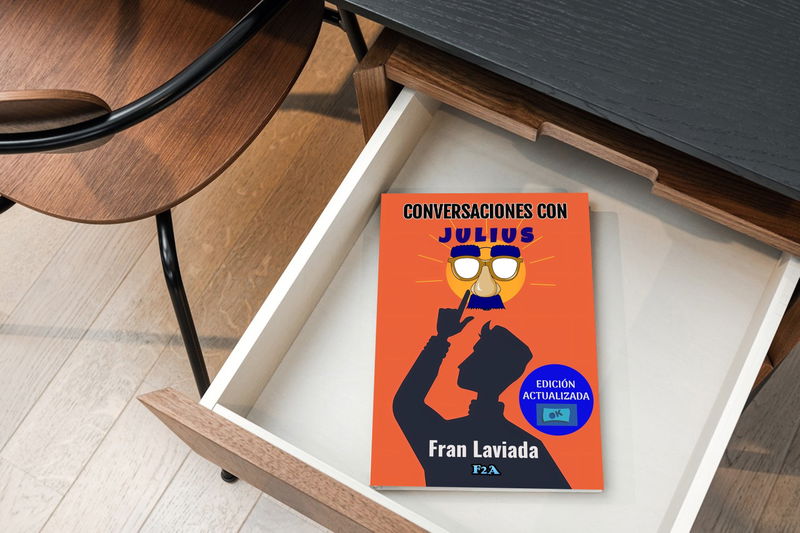
Welcome to Conversations with Julius.
You can read the novel chapter by chapter here at FIKA. But if the story captures you and you don't want to wait for the next installments, you can enjoy the full novel on Amazon, available in eBook and paperback formats.
If you like what you read, leave a comment at the end of each chapter. I'd love to hear your impressions and theories, and to share this journey with you.
Thank you for being here.
If you want to discover more titles by the author, you can visit his website:
A brief recovery pause.
Catching breath…
Breathing deeply…
Regularizing heart rate…
And once again Julius, once recovered (though only slightly, as at certain ages, the recovery periods from any activity performed, whether physical or intellectual, increase considerably), continues with his fertile talk.
Listen carefully! I once said that thing that became so famous:
"Ladies and Gentlemen, these are my principles, and if you don't like them, I have others!" Well, what I was referring to is that many people act with a total lack of ethics in their lives, and they wrap their time on planet Earth in a mantle of frivolity and hypocrisy that makes them change their minds continuously, acting like weather vanes moving at the mercy of the wind others blow, or of circumstances. Many use their principles (or directly have none) like mere currency, based on the benefits they can get in return. It's a form of self-interested bartering very common in modern society.
And speaking of hypocrisy, I once experienced first-hand the falseness of people when I wanted to join a club under my real name, Julius Henry Marx, and they didn't admit me because, at that moment, they didn't know who I was—that is, they didn't know that behind that name a famous character was hidden, and they rejected me. Later, when they realized their mistake, they contacted me, very kindly inviting me to be a member of the most illustrious "Friars Club of Beverly Hills." The hypocrites were aware that having someone famous like me among their members would always be profitable at a publicity level, but all they proved to me was that the person didn't interest them at all; they only valued the fact that I was someone known. Hence my response to their "kind" invitation: I would never belong to a club that would admit someone like me as a member!
I could keep telling you many more things, friend, but I see you look fatigued and it will be better if we leave it for tomorrow. I also need to rest, but first, a few final notes on human behavior. I want to talk to you about superstitions and mistakes—different concepts, even if they both end in 's', though they have a certain relationship. As far as the former is concerned, there are certain types of beliefs—for example, that the number 13 or black cats bring bad luck—and that is obviously not true. Thinking that way undoubtedly leads you to error, and if you carry that over to important decisions in your life, letting yourself be swayed by a series of fetishes, you'll end up making big mistakes that will surely bring serious grief. In the end, what I want you to understand is that in life, when taking important decisions, one cannot be dragged along by a few unreal beliefs that are adulterated or just plain stupid. That's why, regarding superstitions, what I think is that "If a black cat crosses your path, it only means the animal is going somewhere"—in other words, the bad luck business is solemn nonsense. And regarding the matter of errors, I can only tell you something I heard from my good friend Charlie Chaplin—a man of undoubtedly privileged intelligence—when he said: "I like my mistakes; I don't want to give up the delicious freedom of being wrong." Something I subscribe to one hundred percent, because there is no greater independence for a human being than exercising the right to free will without any limitation (without invading the neighbor's, of course). It's another thing whether you get it right or get it wrong, and in the latter case, taking responsibility for the consequences of your failures—but never paying for the errors others have made in your name because you've let them make decisions for you. If you act that way, you will have unknowingly become a marionette; you will have left your life in the hands of your neighbor, who will pull your strings at their whim.
Do you agree, friend?
Paquito did not respond, because without realizing it, he had fallen asleep. At that moment Julius became aware that he had spoken more than he should, and once again, he could see that his loquacity was truly inexhaustible.
"Well, we'll continue, tomorrow is another day!" thought the man with the black mustache and the unlit cigar, making one of his habitual grimaces accompanied by his characteristic wiggle of the eyebrows.

Comments
No comments yet. Be the first to comment!